Buddhism began in a world where access to religious teaching was limited. There were no printed books, recorded lectures, online courses, or digital collections of sutras.
If someone wanted to devote life fully to the Dharma, leaving home and joining the monastic community offered a direct way to study under experienced teachers, memorize scriptures, meditate, and live according to a shared discipline.
Monastic life remains a valuable Buddhist vocation. Monks and nuns preserve teachings, maintain traditions, provide instruction, and demonstrate the practice of renunciation.
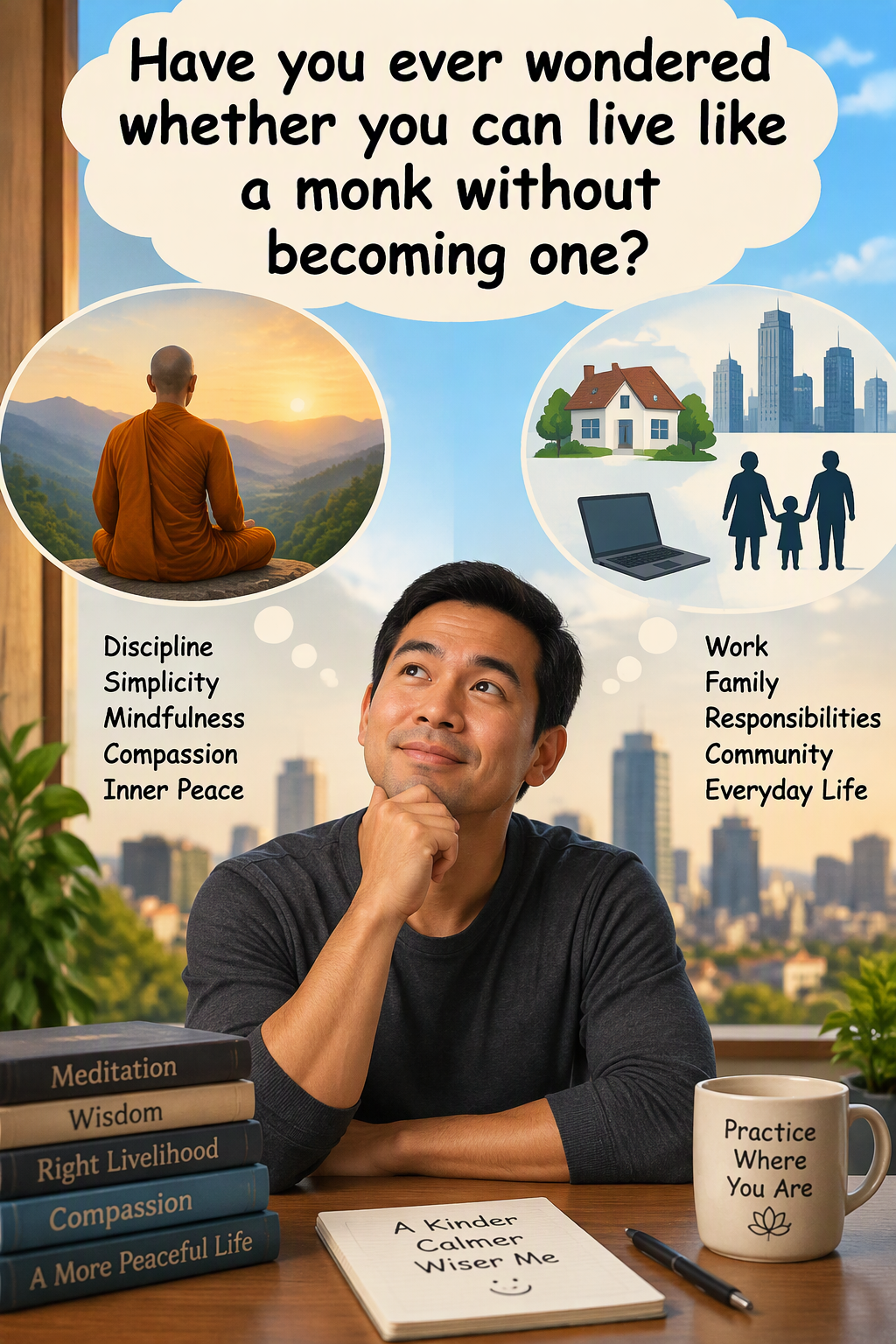
But monastic life is not the only way to practice the Dharma seriously.
Modern householders can study scripture, hear teachings, meditate, practice ethical conduct, serve others, and share the Dharma while maintaining careers, homes, and families.
The Buddha Taught Householders
The Buddha did not teach only monks and nuns.
The Sigalovada Sutta is addressed to a young householder. Rather than telling Sigala to abandon ordinary life, the Buddha teaches him how to live ordinary life well.
The sutra explains the responsibilities between parents and children, teachers and students, spouses, friends, employers and workers, householders and spiritual teachers.
It also warns against the habits that destroy wealth:
“Addiction to intoxicants, roaming the streets at unseemly hours, frequenting shows and entertainments, compulsive gambling, associating with bad friends, and habitual idleness.”
The teaching is practical. A householder should protect wealth, choose friends carefully, support family members, treat workers fairly, and fulfill responsibilities.
These are not distractions from Buddhist practice. They are places where Buddhist practice occurs.
Ordinary Life Contains the Path
The Mangala Sutta describes the highest blessings:
“Well educated,
skilled in a craft,
disciplined,
well spoken speech:
this is the highest blessing.”
It continues:
“Supporting mother and father,
cherishing spouse and children,
engaging in peaceful occupations:
this is the highest blessing.”
These verses do not present education, work, marriage, or family as spiritual failures. They show that ordinary life can be guided by wisdom and compassion.
A career can become a practice of right livelihood. Raising children can develop patience and generosity. Caring for aging parents can become an expression of gratitude. Marriage can teach honesty, fidelity, forgiveness, and mutual support.
The household is not separate from the Dharma. It is one of the places where the Dharma must be lived.
Practice Is Defined by Conduct
Wearing a robe does not automatically make someone wise, and owning possessions does not automatically make someone worldly.
The Dhammapada says:
“One is not a monk
merely because one begs for alms.
One who follows the whole teaching
is truly called a monk.”Dhammapada, verse 262
It also says:
“One is not a monk
because of a shaven head.
If one is deceitful and unrestrained,
one is not a monk.”Dhammapada, verse 267
These verses warn against judging spiritual maturity by appearance alone.
A robe can represent a sincere commitment to monastic discipline. But the robe is not a substitute for truthfulness, restraint, compassion, or wisdom.
In the same way, a house, career, family, and savings account do not prevent a person from practicing the Dharma. The question is whether that person is ruled by craving.
Lay Buddhists Can Practice Seriously
A modern lay Buddhist can establish a disciplined practice without abandoning ordinary life.
A householder can:
- Read and study the sutras.
- Meditate each day.
- Follow the precepts.
- Practice right livelihood.
- Support family members.
- Give generously.
- Serve people who are suffering.
- Attend Buddhist communities and teachings.
- Discuss the Dharma with others.
- Share helpful teachings with humility.
None of these practices require withdrawing from society.
The Dhammapada says:
“You yourselves must strive.
The Buddhas only show the way.”Dhammapada, verse 276
Whether a person lives in a monastery or a household, that person must still do the work of practice.
No institution can meditate for us. No teacher can remove our greed, hatred, and delusion without our effort. No outward identity can replace the daily training of the mind.
The Lotus Sutra Includes Ordinary Practitioners
The Lotus Sutra repeatedly includes monks, nuns, laymen, and laywomen among those who hear, preserve, practice, and share the teaching.
The Sutra of Immeasurable Meanings offers particular encouragement to ordinary people. It says that even those who are still burdened by earthly desires can preach the Dharma so that others may break free from suffering.
It compares such a person to a ship’s captain who remains on this shore but possesses a sound vessel and can explain to others how to cross safely.
This means we do not have to wait until we are perfect before helping others.
A layperson may still struggle with impatience, fear, financial pressure, family conflict, or attachment. Yet that person may also know one teaching that can help someone else.
The Dharma can be shared sincerely from within ordinary life.
Possessions Are Not the Central Question
The Buddhist problem is not simply ownership. It is attachment and addiction to the pleasures of life.
A person may own almost nothing and still be consumed by craving. Another person may own a home, operate a business, and support a family while remaining generous, disciplined, and aware of impermanence.
The Dhammapada says:
“Wealth destroys the foolish,
but not those who seek the far shore.
The foolish destroy themselves
through craving for wealth.”Dhammapada, verse 355
The verse does not say that wealth destroys everyone. It says that craving for wealth destroys the foolish.
The central question is not whether we possess things. It is whether those things possess us.
Can we earn without deceit?
Can we enjoy comfort without becoming dependent upon it?
Can we save without living in fear?
Can we give without resentment?
Can we accept change when possessions are lost?
These are questions of practice.
Respect the Monastic and Lay Paths
Monastic life and lay life should not be treated as separate paths.
Monastics preserve a way of life centered on renunciation, study, meditation, and discipline. Laypeople provide material support, carry the Dharma into families and workplaces, and demonstrate how wisdom and compassion can guide life within society.
The Sigalovada Sutta presents this as a relationship of mutual care.
Householders should support those devoted to spiritual practice through kind actions, kind words, kind thoughts, open doors, and material assistance. Spiritual teachers, in return, should restrain householders from evil, encourage them in good, teach what they have not heard, clarify what they have heard, and show them the path.
Each supports the other.
The goal is not to prove that one way of life is superior in every circumstance. The goal is to reduce suffering and move toward awakening.
Practice Where You Are
A lay Buddhist does not need to wait for retirement, a retreat, or a different life before practicing seriously.
Practice begins in the life we already have.
Meditate or chant before work.
Speak truthfully during difficult conversations.
Earn through peaceful and useful activity.
Treat employees and coworkers fairly.
Support parents and children.
Avoid habits that waste time and wealth.
Study the Dharma regularly.
Give according to your ability.
Share helpful teachings when the time is right.
The path is not elsewhere. It appears in each decision.
Monastic life remains a valuable and worthy vocation. But householders can also live diligently, ethically, and compassionately. They can develop wisdom while fulfilling ordinary responsibilities. They can support the Dharma and help keep it alive in the world.
The central question is not whether we have left home.
The central question is whether we are abandoning greed, hatred, delusion, and harmful conduct wherever we live.
Continue Reading
The teachings discussed in this post are included in the book, The Buddhist Bible: Early Sutras, the Lotus Sutra, and the Complete Code of Conduct. The book brings together the Dhammapada, the Sigalovada Sutta, the Mangala Sutta, the Lotus Sutra, and other important Buddhist scriptures in a clear and accessible collection.
If you would like to study these teachings in greater depth, you can learn more about the book and purchase a copy through the link on the bottom of this site.
Leave a Reply