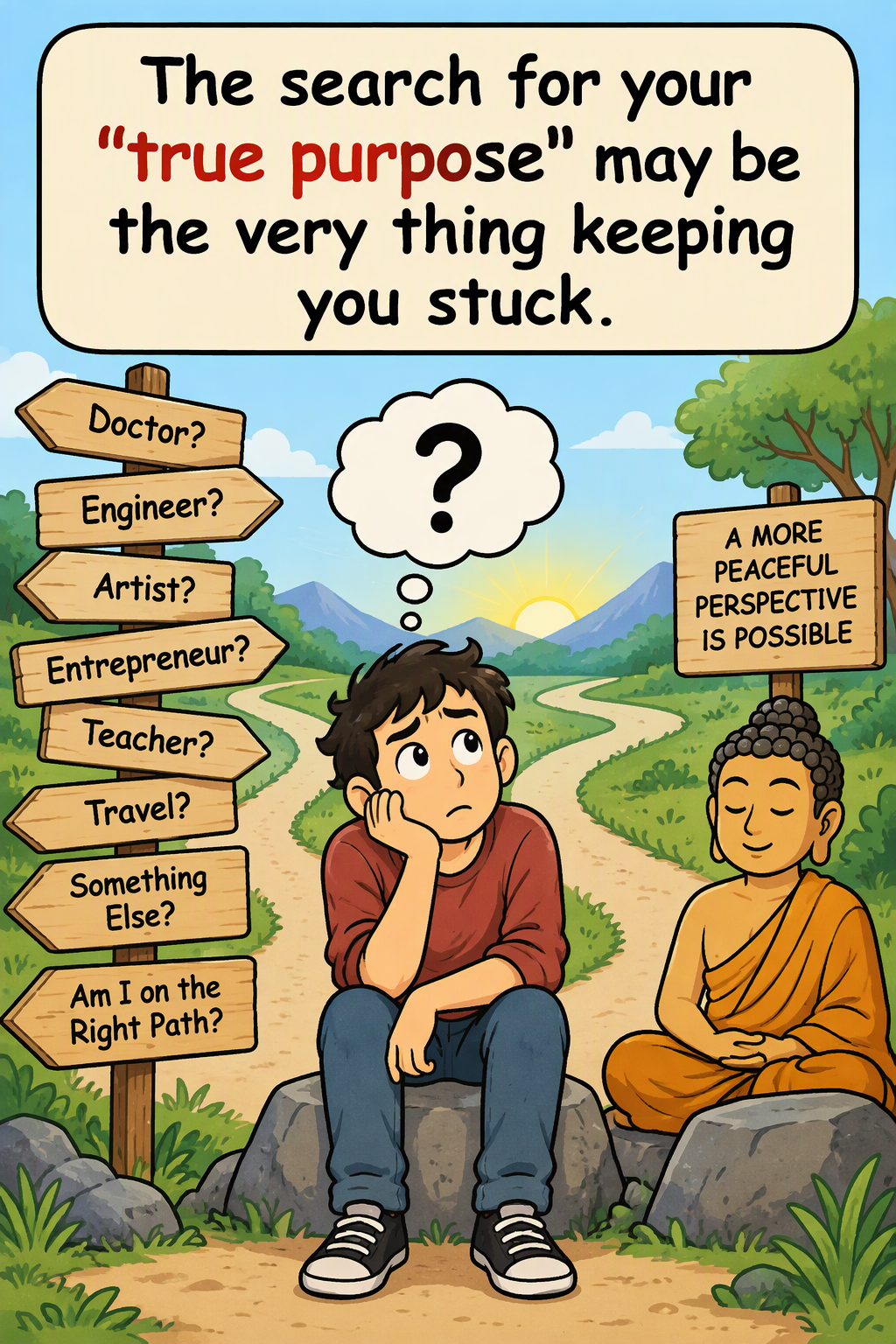
Choosing a career becomes overwhelming when we believe there is one perfect calling that must reveal our permanent identity.
We ask:
- “What was I born to do?”
- “What if I choose the wrong path?”
- “Shouldn’t meaningful work feel exciting all the time?”
- “What if I waste my potential?”
- “What if I change my mind later?”
These questions can turn a practical decision into an impossible search for certainty.
Buddhist wisdom offers a different approach. Instead of asking a job to reveal a fixed “true self,” it asks how work can become a field for ethical action, useful service, discipline, and growth.
You Are More Than Your Job
Modern culture often treats career as identity.
We ask, “What do you do?” and use the answer to estimate a person’s status, intelligence, ambition, or worth. Over time, we may begin evaluating ourselves in the same way.
But a job title cannot contain an entire human life.
You are also your conduct, relationships, habits, values, responsibilities, and way of meeting difficulty. Work is important, but it is not the total measure of who you are.
If your identity depends entirely on your occupation, a layoff, career change, retirement, or failure can feel like personal disappearance.
A healthier career supports your life without becoming your whole self.
Buddhism Does Not Present the Self as Fixed
The Anattalakkhana Sutta explains that the person is not a permanent, unchanging identity that can be completely controlled.
This can be freeing when choosing work.
You do not need to discover one hidden career that perfectly expresses who you will always be. Your abilities, interests, values, and circumstances may change.
The right work for one season may not be the right work for another.
A career choice is not necessarily a lifelong verdict. It is a direction chosen under present conditions.
Choose a Direction, Not a Permanent Identity
Instead of asking, “What job proves who I truly am?” ask:
- What skills can I develop?
- What work avoids unnecessary harm?
- Where can I be useful?
- What environment supports good conduct?
- What responsibilities must this work sustain?
- What am I willing to practice long enough to become competent?
- Does this path leave room for health, relationships, and spiritual growth?
These questions are more practical than trying to identify one perfect destiny.
You are not choosing a permanent identity. You are choosing conditions that will shape your habits and character.
Skill Is Part of a Good Life
The Mangala Sutta praises being:
“Well educated, skilled in a craft, disciplined, well-spoken speech: this is the highest blessing.”
This teaching values learning, useful ability, self-discipline, and communication.
Meaningful work is not always discovered through sudden inspiration. It is often built through patient training.
You may begin with interest but little confidence. As your competence grows, the work may become more satisfying because you can contribute at a higher level.
Ask not only, “What do I enjoy?” but also:
- What can I become good at?
- What useful problem can I learn to solve?
- What kind of effort am I willing to repeat?
- Which skills remain valuable across different roles?
Passion can follow practice.
Consider Right Livelihood
The Noble Eightfold Path includes right livelihood.
This means earning a living in a way that does not depend upon avoidable harm, deception, exploitation, or corruption.
No workplace is perfect, and many industries contain ethical complexity. The question is not whether a job is flawless. It is whether your work allows you to act with reasonable integrity.
Consider:
- Does this work require dishonesty?
- Does it exploit vulnerable people?
- Does it profit primarily from harm?
- Can I treat customers, coworkers, and employees fairly?
- Can I perform the role without betraying my conscience?
- Does the workplace reward conduct I do not want to develop?
A higher salary cannot fully compensate for work that repeatedly trains you to ignore your values.
Look at the Environment, Not Only the Role
The same job can feel very different in two organizations.
A position may fit your skills but place you in a culture of fear, humiliation, dishonesty, or constant exhaustion. Another workplace may offer less status but more respect, learning, and stability.
Before accepting a role, look for evidence:
- How do leaders treat people with less power?
- Are expectations clear?
- Is learning encouraged?
- Are mistakes addressed constructively?
- Do employees appear chronically afraid?
- Is turnover unusually high?
- Are boundaries respected?
- Does the organization behave consistently with its stated values?
You are not only choosing tasks. You are choosing an environment that will influence your mind and behavior.
Meaningful Work Must Also Sustain Life
Work should be evaluated spiritually and practically.
A meaningful career that cannot reliably support basic responsibilities may require adjustment. A stable job that destroys your health or relationships may also be too costly.
The Mangala Sutta praises supporting parents, cherishing spouse and children, and engaging in peaceful occupations.
Work exists within a network of responsibilities.
Ask:
- Will this income meet essential needs?
- Is the schedule sustainable?
- What sacrifices will the work require?
- Are those sacrifices temporary or permanent?
- Does this path support the people who depend on me?
- Can I maintain my health and important relationships?
Purpose matters, but sustainability matters too.
Where Can You Be Useful?
Career advice often focuses entirely on self-expression: “What do I want?”
Buddhist wisdom adds compassion: “Where can I reduce suffering or create benefit?”
Usefulness does not require a glamorous profession. A person can contribute through healthcare, teaching, administration, construction, caregiving, technology, food service, transportation, art, maintenance, or countless other forms of work.
A role may be meaningful because it:
- solves a real problem;
- supports a family;
- makes a system function better;
- protects others;
- provides beauty or understanding;
- creates stability;
- helps people through difficulty.
Work gains meaning when ability meets a genuine need.
Do Not Chase Status at the Expense of Peace
Some careers are pursued less from interest than from the desire to appear successful.
The Dhammapada teaches that the wise are not shaken by praise or blame.
If your career depends entirely on external approval, satisfaction will remain unstable. There will always be someone with a higher title, larger income, or more recognition.
Ask:
- Would I still value this work if fewer people admired it?
- Am I pursuing this because it fits-or because it impresses?
- What am I willing to sacrifice for status?
- Will this achievement create a life I actually want to live?
Status can accompany useful work, but it should not be mistaken for meaning.
Test a Direction Before Making It an Identity
You do not have to understand a career completely from the outside.
When possible:
- interview someone doing the work;
- take a class;
- volunteer;
- shadow a professional;
- complete a small project;
- pursue an internship;
- work part-time in the field;
- study real job descriptions.
Experience provides information that imagination cannot.
A small test can reveal whether you enjoy the daily activities-not merely the title or idea of the profession.
Make the Next Wise Move
Sometimes circumstances do not allow you to pursue an ideal role immediately.
You may need to keep a stable job while building skills, caring for family, reducing debt, or recovering your health.
That does not mean you have failed. A practical transition can still move in the right direction.
Your next step might be:
- updating your résumé;
- learning one transferable skill;
- applying for one position;
- asking for mentorship;
- saving for training;
- requesting different responsibilities;
- leaving an unethical workplace;
- improving how you perform your current role.
You do not need the entire career mapped out. You need the next responsible movement.
Let Work Shape Character
Every job trains something in you.
Work can train patience, attention, reliability, communication, courage, humility, or generosity. It can also strengthen impatience, dishonesty, greed, arrogance, or indifference.
Ask at the end of the day:
- What did this work practice in me?
- Did I speak truthfully?
- Did I treat others fairly?
- Did I perform my responsibilities carefully?
- What skill or virtue can I strengthen tomorrow?
Even an imperfect job can become part of the path when approached with mindfulness and integrity.
The Lesson
You may not find yourself by discovering a perfect job. You may build yourself through skillful work.
Choose a direction that allows you to develop useful skills, support your responsibilities, avoid unnecessary harm, and contribute something of value.
A career does not have to express every part of you. It should provide an ethical field in which competence, contribution, and wisdom can grow.
The right career is not always the one that finally tells you who you are. It may be the one that helps you practice who you want to become.
Continue Reading
Explore work, discipline, useful skill, right livelihood, and responsible household life in the Mangala Sutta, the Sigalovada Sutta, the Dhammacakkappavattana Sutta, and the Anattalakkhana Sutta in The Buddhist Bible: Early Sutras, the Lotus Sutra, and the Complete Code of Conduct, see the link below.
Leave a Reply