Buddhism warns repeatedly against greed, craving, and attachment. Because of this, some people assume that poverty is spiritually superior to prosperity.
But the Buddha did not teach that deprivation is the answer to greed. His first teaching rejected two extremes: indulgence in sensual pleasure and harsh self mortification. Between them, he taught the Middle Way.
The same principle can guide our relationship with money.
We do not have to choose between uncontrolled accumulation and deliberate poverty. A Buddhist householder can earn ethically, spend thoughtfully, save for the future, avoid waste, and give generously.
The Middle Way Rejects Two Extremes
In the Dhammacakkappavattana Sutta, the Buddha says:
“There are two extremes that one who has gone forth should not follow: devotion to sensual indulgence, which is low, common, worldly, ignoble, and unprofitable; and devotion to self mortification, which is painful, ignoble, and unprofitable.”
The Buddha had personally experienced both extremes. Before leaving home, he lived surrounded by comfort. Later, he practiced severe deprivation until his body became weak.
Neither extreme produced awakening.
The Middle Way does not mean dividing the difference between luxury and poverty. It means refusing to be ruled by either indulgence or self punishment.
Money should be used wisely, not worshipped and not feared.
Greed Is Not the Same as Prosperity
The Dhammapada says:
“Wealth destroys the foolish,
but not those who seek the far shore.
The foolish destroy themselves
through craving for wealth.”Dhammapada, verse 355
This verse makes an important distinction. Wealth does not destroy everyone. Craving for wealth destroys the foolish.
A person may earn a large income without being greedy. Another person may have very little money and still be consumed by envy, comparison, fear, and resentment.
Greed is not measured only by how much we possess. It is revealed by our relationship with what we possess.
Do we believe that more money will finally make us complete? Do we sacrifice honesty, health, family, or compassion in order to gain it? Are we unable to give because we are terrified of having less?
If so, wealth has begun to possess us.
Contentment Does Not Mean Refusing Prosperity
The Dhammapada says:
“Contentment is the greatest wealth.”
Dhammapada, verse 204
Contentment is sometimes confused with passivity. But contentment does not mean refusing to improve our lives or neglecting the abilities we could develop.
A contented person can still work toward prosperity. The difference is that peace is not always postponed until the next promotion, purchase, or financial goal.
Contentment allows us to say, “What I have is enough for happiness, but I will continue building what is needed for responsibility, security, and service.”
This is very different from laziness.
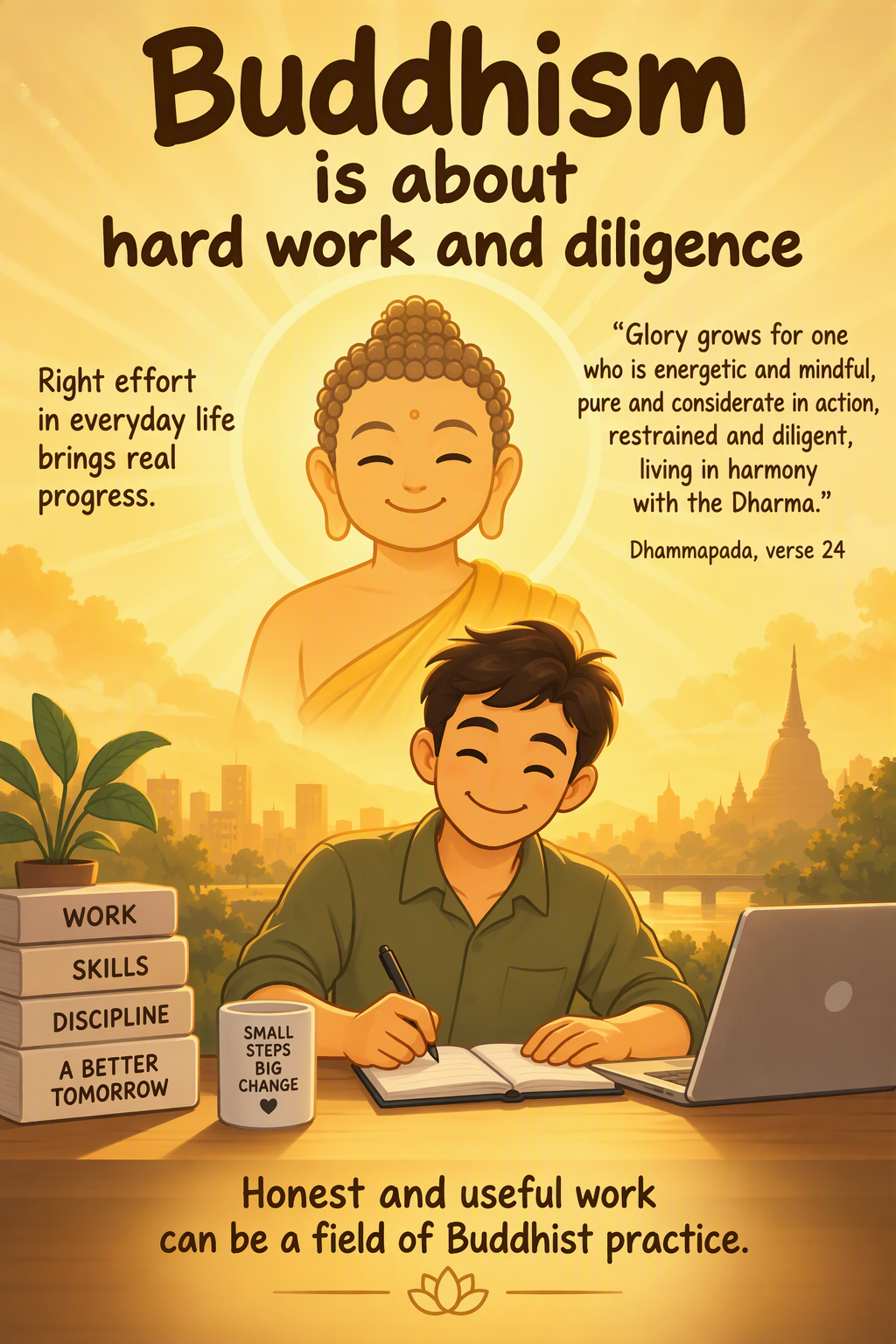
The Buddha praised diligence, useful skills, peaceful occupations, and the support of parents, spouses, and children. Developing our abilities can be part of fulfilling these responsibilities.
Simplicity Means Avoiding Waste
Simplicity does not require having nothing. It means using what we have carefully.
The Sigalovada Sutta warns against habits that destroy wealth, including intoxication, compulsive gambling, harmful companions, constant distraction, and habitual idleness.
These warnings show that preserving wealth is not contrary to Buddhism. Carelessness creates suffering, not only for ourselves but also for those who depend upon us.
A simple financial life may include:
- Earning through honest and useful work.
- Spending according to real needs.
- Avoiding purchases made only for status.
- Maintaining what we already own.
- Saving for illness, old age, and unexpected difficulty.
- Refusing habits that quietly consume our resources.
- Giving to people and purposes that reduce suffering.
Simplicity is not the rejection of comfort. It is freedom from waste, excess, and restless consumption.
Saving Is an Act of Foresight
Saving money is sometimes treated as a sign of attachment. It can become attachment if it is driven entirely by fear or if accumulation has no limit.
But saving can also express wisdom.
Future needs are real. Bodies become ill. Employment changes. Parents age. Children need support. Homes require repair. Opportunities arise that require resources.
Preparing for these conditions is not a denial of impermanence. It is a response to impermanence.
The Dhammapada warns against reaching old age without having developed either the holy life or material security:
“Those who have not lived the holy life,
who have not gained wealth in youth,
lie like broken bows,
lamenting the past.”Dhammapada, verse 155
The teaching encourages us to use present strength and opportunity wisely.
Generosity Completes the Balance
The Middle Way does not end with earning and saving. Wealth should also circulate toward what is good.
The Dhammapada says:
“Misers do not go to the heavenly realms.
Fools do not praise generosity.
But the wise rejoice in giving.”Dhammapada, verse 177
Generosity prevents savings from becoming hoarding. It reminds us that money is a tool for relieving suffering and supporting life.
We can give to relatives in need, people facing hardship, Buddhist teachers and communities, charitable work, education, medical care, and the preservation and sharing of the Dharma.
Wise generosity is not reckless. We do not have to impoverish ourselves or neglect our responsibilities. We give according to our means, with compassion and clear judgment.
A Balanced Buddhist Approach to Money
A practical Middle Way may be summarized simply:
Earn without harming.
Spend without carelessness.
Save without fear.
Enjoy without attachment.
Give without pride.
Money cannot provide a secure refuge from aging, illness, change, and death. But this does not make money useless. Properly earned and wisely managed, it can reduce avoidable suffering, protect a family, create opportunity, and support the Dharma.
The Buddhist choice is not greed or poverty.
It is wise stewardship.
Develop your abilities. Work honestly. Build security. Live simply. Avoid waste. Share what you can. Remember that prosperity is useful, but it is not the purpose of life.
Walk the Middle Way between being controlled by money and refusing to use money wisely.
Continue Reading
The teachings discussed in this post are included in my book, The Buddhist Bible: Early Sutras, the Lotus Sutra, and the Complete Code of Conduct. The book brings together the Dhammapada, the Sigalovada Sutta, the Mangala Sutta, the Lotus Sutra, and other important Buddhist scriptures in a clear and accessible collection.
If you would like to study these teachings in greater depth, you can learn more about the book and purchase a copy through the link on the bottom of this site.
Leave a Reply